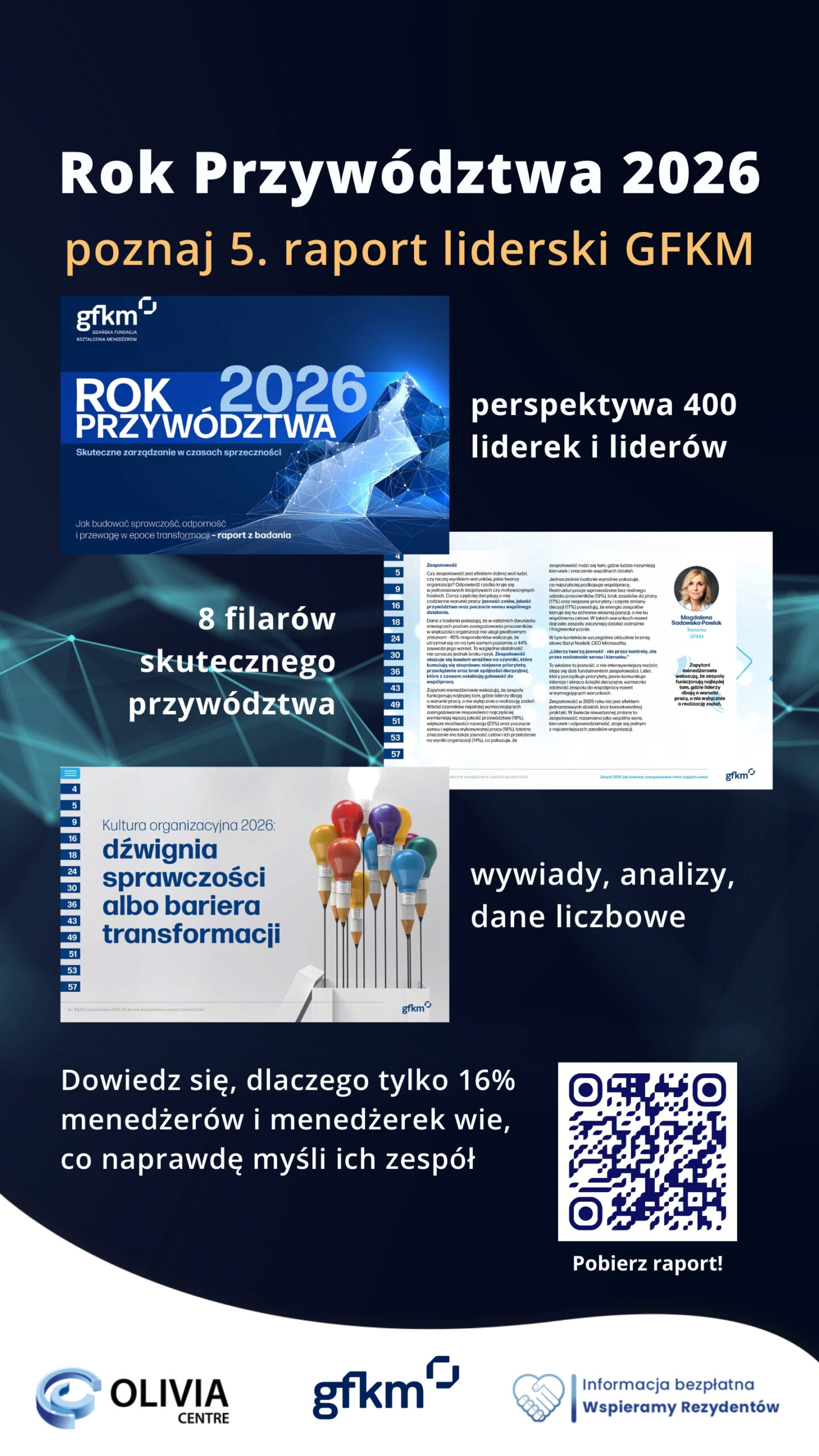


In a world of cumulative changes, transformation ceases to be a project. It becomes a competence – organizational and leadership. Get to know the “Year of Leadership 2026” report, prepared by our resident, GFKM (Gdańsk Foundation for Management Education). This is the fifth edition of the survey – previously carried out under the name “Year of the Leader” – which provides an in-depth diagnosis of the condition of leadership in Poland year after year.
A survey based on data, not sentiment
The report is not a soft opinion survey or a set of general reflections. It is a practical tool for assessing the quality of decisions, operational risks and the resilience of an organization in times of contradiction.
In this year’s edition:
- 400 leaders from small and medium-sized companies and large organizations were surveyed,
- In-depth qualitative interviews with managers were carried out, allowing to capture the context and real decision-making mechanisms.
The respondents were asked, among other things, about:
- effective management in conditions of conflicting expectations,
- transformations planned for 2026,
- organizational culture as the foundation for strategy implementation,
- challenges related to strengthening and motivating teams.
This combination of quantitative and qualitative data allows you to look at leadership not only through the prism of declarations, but through real decision-making experience.
Diagnosis of 2025 and forecast for 2026
The report shows that 2025 – despite the increase in operating costs – was seen as a time of relative stability. At the same time, leaders point out that the key challenge is no longer individual goals, but the efficiency of the entire organization is becoming one.
The conclusions are unambiguous:
- Effective change is not just about implementing it, but about involving people in its design,
- Organizational culture is becoming a real test of agency – although most leaders declare their support for the strategy, as many as 91% of companies have difficulty translating values into everyday practice,
- The year 2026 promises to be a time of accumulation of change, which means that leadership competencies will be defined primarily by the ability to guide people through the transformation process.
The report answers key questions:
- How do leaders sum up 2025 – what was the biggest challenge and what was the disappointment?
- What are their hopes, fears and priorities for 2026?
- In which areas of development do they see an advantage in the coming year?
- What – despite the tensions – fills them with optimism?
Eight Pillars of Leadership and Recommendations
The report organizes the conclusions around the eight pillars of leadership that define the effectiveness of transformation and the quality of decisions in organizations in 2026. Each of the pillars has been supplemented with specific implementation recommendations.
Importantly, the report contains separate indications for management boards, middle managers and HR departments, taking into account their different perspectives, scope of responsibilities and impact on organizational culture. Thanks to this, the publication is not only a diagnosis, but also a practical map of activities for the entire management structure.
Presentation at the Olivia Centre
The conclusions of the report were presented during the 34. Meetings of the Olivia Centre HR Club, becoming a starting point for discussions about the quality of decisions, organizational culture and the readiness of companies to lead people through change.
The meeting showed that there is a growing need in the business environment to talk about leadership understood not as a position, but as the ability to build agency, resilience and effectiveness under pressure.
How to build an advantage in times of contradiction? What competencies do leaders need in 2026? You will find the answers in the “Year of Leadership 2026” report.