


The office market in recent years can be summed up in one word: volatility. The pandemic, the change in the model of work from office to hybrid, changes in energy costs, labor codes, labor costs and the entry of artificial intelligence mean that “flexibility” can be announced as the key slogan in the commercial real estate sector. The winner is the one who can listen to the market and adapt to changes. This is not only a tip for everyone who runs a business, but also for the entire business support sector: from suppliers of office supplies or fruit for the office, to the owners of the largest business centers. With the level of volatility observed in recent years, each of these industries had to learn to function in the new reality.
The changes that we all observe cause the need to hire, lay off, select space or release it, and incur the costs of office rearrangement. And with such dynamic external conditions, these activities often require really considerable operational skills and meeting the considerable costs of these processes.
It is for these reasons that the choice of the location where the business is conducted is crucial. The realities of recent years mean that our Residents need a partnership approach and understanding of their current needs and even more flexibility – says Michał Klepczyński, Director of the Commercialization Department at Olivia Centre. – In previous years, there were more frequent situations when companies were growing dynamically and needed effective support from us in the area of space selection. As a rule, this is not a challenge if the space is available within the same building. The problem arises when the demand increases during the ongoing contract and the possible development options are only available in other buildings. Olivia was created for such tenants, where 180k m2 of space is in the hands of a single managing entity that designs, commercializes and manages all space. This allows us to move growing residents even during the term of the lease agreements and allow them to develop on a new larger space within a single building and contact.
Currently, such dynamic growth scenarios as in previous years occur less frequently, companies scale more slowly, and the growth of their business is not always associated with an increase in demand for space. Due to the persistence of the hybrid work model, companies much more often need support in optimizing the leased space, and this raises a number of challenges, also on the part of the facility manager. The scale of the challenge is well known to architects, interior designers and contractors, who are responsible for adjusting the space to the standards expected by new tenants. The tasks they face are important, because even if the offices they are handed over are finished to a high standard, the new tenant has their own preferences and it is not uncommon to need a significant rearrangement of the space before it is possible to move into the vacated office. As confirmed by Artur Kuczyński, responsible for the Design Anatomy design office, as well as the finishing company Construction +, the number of such orders is growing every year: Every year we rebuild tens of thousands. m.kw. different types of surfaces. However, by working in the design & build formula, we can significantly reduce the budgets of these tasks and have a very flexible approach to project implementation. Experience has taught us to organize processes in such a way that instead of generating unnecessary costs, we focus on making the most of the potential of the existing spaces. Working together with the client allows you to provide comfort and peace of mind for both customers and the owner of the facility.
An example of smaller-scale development is Sea Global, which provides engineering and technical consulting for the energy industry, particularly offshore. For Sea Global, choosing the right work environment and business environment remains an important part of its development. Sea Global has its offices in Olivia Centre, which is adjacent to other companies from the energy sector, such m.in: Polskie Sieci Elektroenergetyczne, Energa from the Orlen Group, as well as a branch of PEJ, responsible for the construction of the first Polish nuclear power plant, and a number of other potential co-operators and companies providing business support services. As Angelika Gojdycz, Operations & Marketing Specialist at Sea Global, emphasizes, the conclusions from the choice of the location of the office turned out to be a very good direction: From the beginning of Sea Global’s presence in Poland, the location in Olivia Centre was the first and logical choice. An important element was also the efficient functioning of the office space and access to fully equipped infrastructure. The whole thing was complemented by the commitment of Olivia’s team and their openness to the needs of the community, which translated into a comfortable and well-organized work environment.
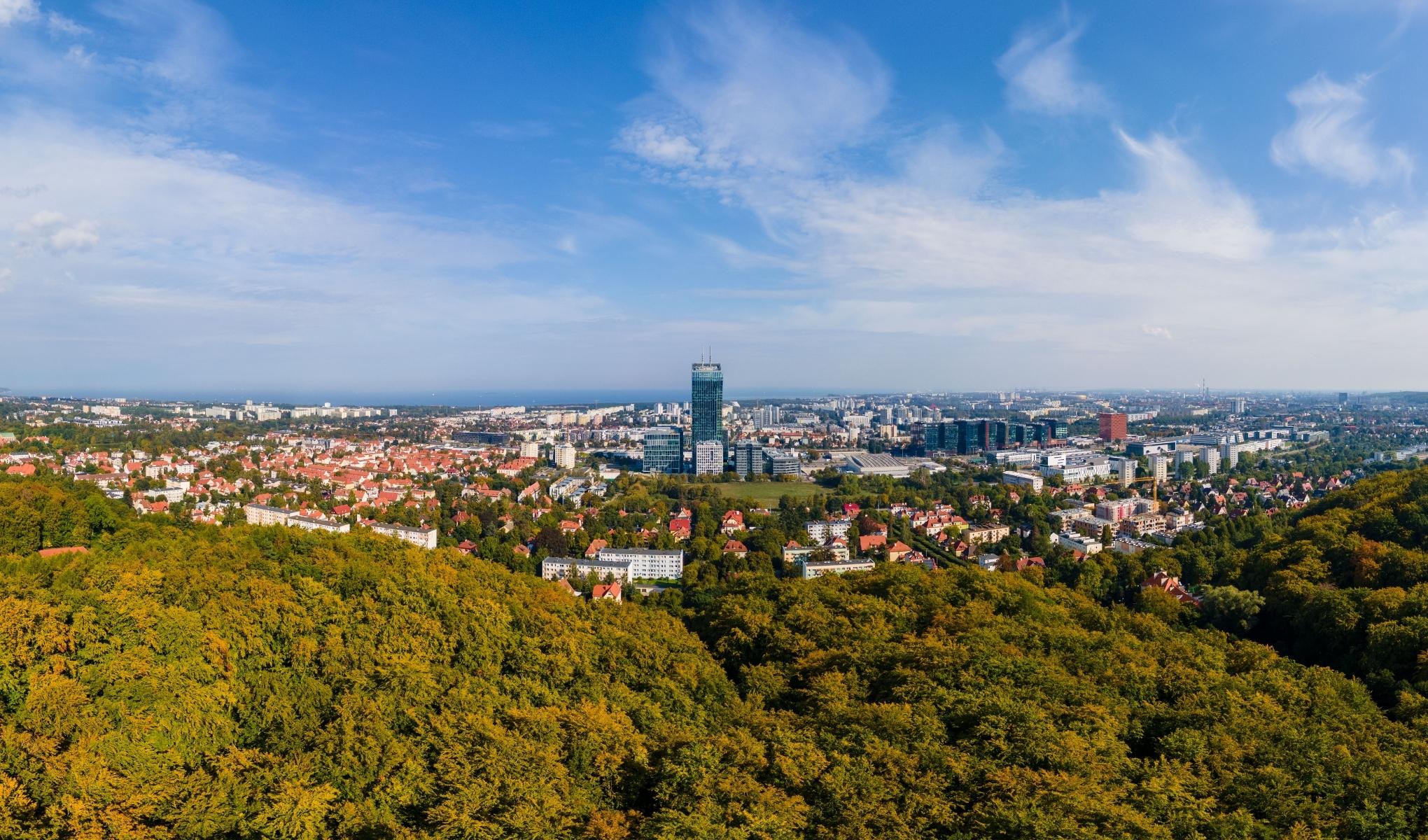
Representatives of other companies also speak in a similar tone. Kamil Parafiniuk, a member of the management board of Develocraft , emphasizes that one of the goals that the company has set for itself since the beginning of its existence was to find a location thanks to which they could develop their business: We chose this place because we want to be part of the vision that Maciej Grabski initiated in 2011. This is where the business heart of the Tri-City beats. By choosing Olivia, we have become part of the largest business hub in Northern Poland. We are continuing the strategy launched in 2025, which aims to attract foreign investments to Polish, with particular emphasis on the potential of Gdańsk. A prestigious location, which we indicate as a priority when inquiries from investors, is a big advantage. What is worth adding is that there are many companies in Olivia that have started working together, thanks to the same place of business.
It also happens that companies try to look for subtenants on their own, but this rarely brings good results due to the lack of knowledge of the market and the lack of human resources experienced in this type of processes. These are often difficult and time-consuming procedures, requiring first finding a new tenant, and then coordinating financial, legal and technical issues related to the division and adaptation of space for both the applicant and the new tenant – says Michał Klepczyński. From the perspective of the facility manager, we have to look at the rental rate in the remaining buildings. To put it simply – supporting the tenant and introducing him to the office during the term of the main tenant’s agreement means that we resign from filling another vacant space in the complex. When approaching cooperation in the long term, because this is what we try to operate in – it is the partnership approach, flexibility and support in difficult situations that build our reputation on the market, and above all, create relationships and trust. This is often one of the foundations when choosing Olivia as a place for further business development.
Additional opportunities for tenants are provided by the presence of a coworking facility in the facility, the lease rules of which are generally much more flexible than standard offices, and often it is coworking that is an excellent solution during transition periods, or during the implementation of longer projects by tenants. Special events organized by coworking spaces for their community are also an added value. Events, workshops and conferences serve to expand knowledge, but above all to network and business development.
As Marta Moksa, director of O4 Coworking at Olivia Centre, emphasizes, flexibility is inscribed in O4’s DNA: When we study the satisfaction of our customers, it is flexibility, openness to tenants’ expectations and their needs that are among the first associations with us. However, flexibility is always emphasized as the most important factor determining tenant satisfaction. And we interpret it in many ways: the first is a flexible form of office rental. That is, renting office space for short periods, with the option of changing at any time. A change can mean quickly choosing a space for a moment or permanently, reducing it or even giving it up in moments of turmoil. This possibility of looser bonding is crucial for many bosses – recent years have shown that you can have 10 employees in one month, 40 in the next, and then go down to 5 in a moment. Thanks to a flexible contract and having almost a hundred offices (from 3 to 36 people), we are able to be a key operational partner of our Clients. This group of needs also includes large corporations implementing temporary projects or opening new branches in the Tri-City. It is also important for them to be able to use the space for a few months, and finally rent their own office, most often in Olivia Centre.
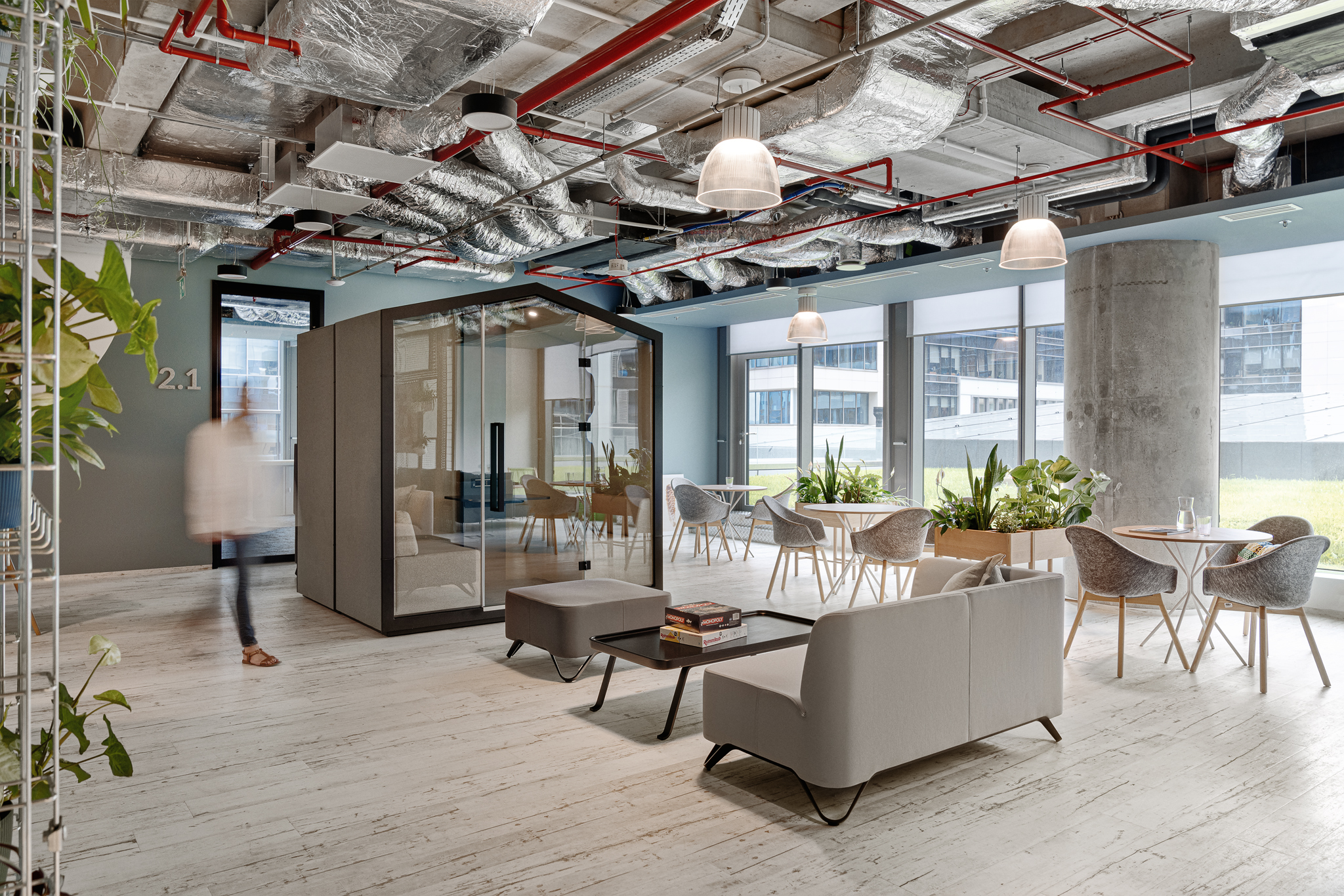
O4 Coworking | Olivia Star
As Marta Moksa emphasizes, flexibility is also the need to respond to the ever-changing needs of customers: We have learned that nothing is impossible for us. Integration event? We will help! Development workshop? We will implement it. Recruitment, especially of young people? That’s why we’re doing the 8th edition of Speed Recruitment Dating. Building a network? That’s why we have conferences that have already become a permanent part of our calendars: LeadWell and Captain’s lunch. Sometimes there are also such unusual requests as renting a ping-pong table, and we can also meet them.
The development of a flexible form of business support is an added value in large office centres, offering opportunities that a smaller supplier will never provide. It not only allows the companies themselves to grow, but also affects the competitiveness of the center, and experience shows that flexibility and a wide range of support are important for both SMEs and large corporations.