


On February 10, 2026, exactly 100 years have passed since Gdynia was granted city rights. This is one of the fastest and most symbolic urban development stories in Poland: a small town on the Bay of Gdańsk has become a modern city-port, designed “from scratch” and oriented towards the future.
The foundation: the port and the state project of modernity
Gdynia in the Second Republic of Poland became a response to the real need for Polish independent access to the sea. The construction of the temporary port began in the spring of 1921, and the formal beginning of the Port of Gdynia is the Sejm Act of 23 September 1922 – it was the port that initiated the demographic, infrastructural and economic development of the city.
It is most often said that Gdynia was “designed” by Eugeniusz Kwiatkowski. In fact, he was a strategist and architect of ideas – a man who determined the creation of the city-port, provided political and financial support for the investment, and gave it a symbolic dimension of modern Polish. However, the actual spatial shape of Gdynia was developed by a team of urban planners and architects, primarily:
- Roman Feliński – chief planner of Gdynia’s development in the 1920s and 1930s; co-creator of a clear layout of streets, relations between the center and the waterfront and the logical division of the city into port, residential and representative functions.
- Adam Kuncewicz – co-responsible for the concept of spatial development and the connection of the city with the port facilities.
They were the ones who made Gdynia not a chaotic investment entity, but a coherent urban organism, where the port, downtown and residential districts complemented each other.
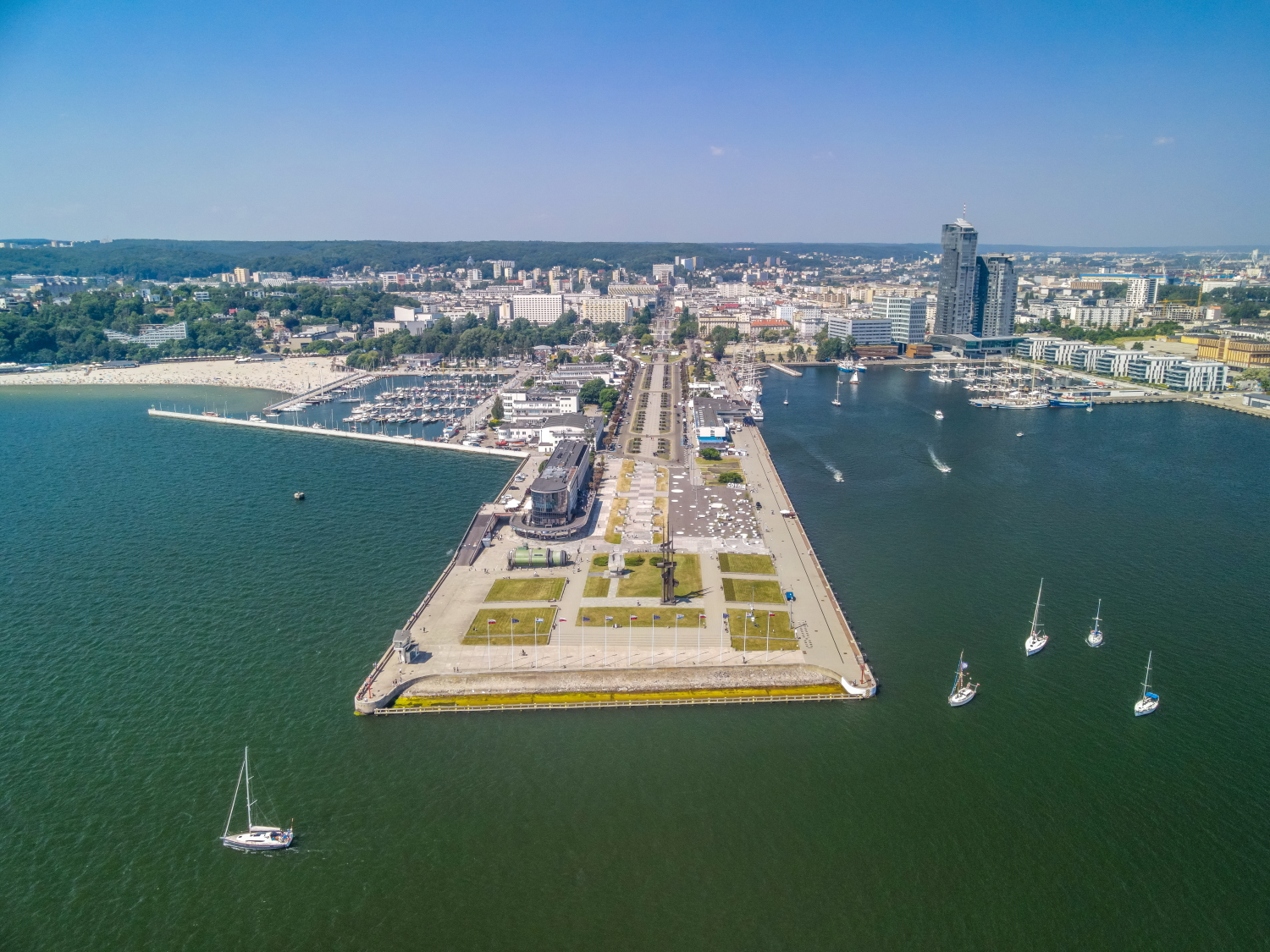
@jkszphotography | freepik
An icon of interwar modernism
The centre of Gdynia is unique on a European scale as a coherent ensemble of modernist interwar architecture. In 2015 the modernist centre of Gdynia was declared a Monument of History; In the official materials of the city, m.in scale of the area (approx. 88 ha) and the number of facilities (approx. 450 buildings) are emphasized.
Characteristic features of Gdynia’s modernism are:
- simple, geometric solids,
- horizontal window strips (so-called “ship windows”),
- corners emphasized by semicircular towers,
- terraces, loggias and glazed staircases,
- Aesthetics inspired by ship architecture and functionalism.
The most important buildings and their creators
- The Sailor’s House (1937–1938) – designed by Jerzy Müller
An icon of Gdynia’s modernism over Kościuszko Square; A light, horizontal body with characteristic window strips and a maritime character. - Tenement house of Bank Gospodarstwa Krajowego (1936) – design. Zbigniew Kupiec, Stefan Reychman
The monumental and at the same time elegant façade at 10 Februara Street is an example of institutional modernism of the highest class. - Bank Polish (1930–1931) – designed by Wacław Tomaszewski, Jerzy Müller
A building combining functionalism with representativeness; One of the best composed facilities in the city centre. - PLO building (1937–1939) – designed by Zbigniew Kupiec
A symbol of the maritime character of the city — simple, rhythmic, modern. - Tenement house at 26–28 Abrahama Street (1936) – designed by Tadeusz Jędrzejewski
An exemplary example of a modernist tenement house in Gdynia with a corner accent and a “ship” detail.
The entire downtown complex shows that Gdynia was not only a port city, but also a laboratory of modern architecture, where Polish architects tested European ideas of functionalism and modernism.
A city of culture and major events
Over the decades, Gdynia has built a brand of a city of festivals and ambitious initiatives:
- Polish Film Festival in Gdynia (FPFF) – the most important celebration of Polish cinema; the festival started in 1974 and was moved to Gdynia in 1987.
- Open’er Festival – one of the largest music events in the region, organized in Gdynia and the municipality of Kosakowo (Gdynia-Kosakowo Airport); The 2026 edition is announced on the official website of the event.
- Gdynia Design Days – a festival of design and urban innovation (in recent editions with a program of exhibitions, debates and installations).
Marine DNA: symbols and places that “make” Gdynia
The image of the city is also built by institutions and facilities that talk about the sea and mobility:
- Emigration Museum – opened on 16 May 2015 in the historic Maritime Station; tells about the experience of departures and returns of Poles.
- ORP “Błyskawica” – since 1976 it has been functioning as a museum ship (within the structures of the Naval Museum).
- Gdynia Aquarium – has been operating since 1971 and is one of the most recognizable educational attractions of the city.
100th anniversary as an excuse to tell the story of the city anew
In the communication about the jubilee, there is a thought that “it began with the sea”, and the celebrations are to last not only one day, but throughout the year – as a joint celebration of residents and guests.
Sources:
The history of Gdynia in a nutshell
History of the construction of the port: Gdynia City Museum; Port Gdynia
Trojmiasto.pl “Gdynia as you don’t know it”
Beautiful modernism: Bankowiec, or a residential complex in Gdynia