


We invite you to the next exhibition in the Olivia Art series. This time, in the lobby of Olivia Star, we present works by Aneta Iwona Oniszczuk-Jastrząbek. The artist, professionally affiliated with the University of Gdańsk, has always shown a natural aptitude for drawing and painting. However, she consciously decided to develop this passion in 2012, when she encountered professional painting at the Color Spa in Sopot. A year later, her artistic journey resulted in her first intimate exhibition. She draws inspiration from contemporary painting rooted in abstraction and minimalism, and her works are a record of personal experiences and a subjective interpretation of reality, without attachment to a single style. Conversations and meetings with Beata Polak-Pela had a significant influence on her way of thinking about painting. After a brief break, she returned to active artistic practice in 2019, alongside her intensive professional work as Vice-Rector for Digitalization and Internationalization at the University of Gdańsk.
Let’s give the floor to the artist herself, who describes the creative process in this way…
“Between the horizon and the glass”
The exhibition “Between the Horizon and the Glass” was created from one simple gesture: a view from above. Of the 32. Olivia Star floors. A building that is itself a story of modernity, ambition and light reflecting off the glass facades, and from which there is a view that cannot be confused with any other. Here Gdańsk shows its fullness: the sea, moraine forests forming into soft waves, the city’s buildings and a sign of its history – cranes. From this perspective, man stands as if between the material, technological, glass world – and the world of nature, space, light and the silent presence of the horizon.
This exhibition is an answer to a question that arose right there, on the observation deck: What do I see between where I am standing and the horizon line?
This view opens up a whole range of images: container ships sailing across the Gulf, cutters resting on the shore in winter, monumental shipyard cranes, beaches, the sky, the waves of the Baltic Sea, the interiors of the Olivia Star restaurant, as well as Star itself – a building so often seen that it almost becomes a hero of everyday life.
Each of these performances is a fragment of the same panorama. A record of a person’s relationship with a place that changes with the movement of the sun, the seasons and the rhythm of the city.
The paintings “Olivia Star” and “Blue Olivia Star” introduce the viewer to the center of modern Gdańsk. In these works, architecture is both an object and a mirror, a structure that reflects the sky and at the same time becomes a part of it. It is a painterly interpretation of the contemporary cityscape.
In contrast to the monumentality of the glass building stands “Bodega in Olivia Star” – an intimate, sensual impression of the interior. Shelves full of wines turn into a game of color, and the refracted perspective opens up a space that feels more like a memory than a realistic record. It is here that the tension between glass and the horizon takes on a personal, intimate dimension.
The paintings “Container Ship” and “Gdańsk – City of Cranes” are a story about the economic and historical identity of Gdańsk. Container ship – built from rectangles of colors – is a symbol of global flows, movement and changes that take place just beyond the horizon line. It is a world of transport, trade, ecological anxiety and international connections, presented in the form of a painterly dialogue between the rhythm of containers and the calm of the sea.
Cranes, on the other hand, are a symbolic point. Green colossi inscribed in the memory of the city. In the painting “Gdańsk – the city of cranes” , they become a sign of freedom, transformation and personal history of the artist. It is a landscape in which it is impossible to separate space from emotions, because in Gdańsk cranes are both topography and memory.
In the painting “The Baltic Sea – Our Sea” , the sea is shown not as a photograph of holidays, but as a scientific, geological and historical landscape. The Baltic Sea is not blue like the Adriatic or turquoise like the Mediterranean Sea. It is grey-green, changeable, difficult, and at the same time deeply painterly. Water becomes a medium of memory here – it combines colours, history, amber, shipwrecks and the everyday rhythm of ports.
In “Wintering Boats on the Shore” and “Morning in Jelitków” , there is a space where the city ends and the sea begins. Boats wintering on the shore are an image of pause – a temporary suspension between seasons, between water and land. “Morning in Jelitków” , on the other hand, is a landscape at dawn, in which the first light opens the day over an empty beach. Both paintings show that the space “in between” – between land and sea, sleep and day, work and rest – has its own, autonomous world.
All the paintings, from the glass walls of Olivia Star, to shipyard cranes and container ships, to beaches and cutters, form one common narrative: a record of what lies between man and the horizon. It is a painterly response to the experience of looking from above, but also looking into the depths – into the city’s past, into the artist’s personal memories, into the rhythms of everyday life, which are seemingly ordinary, but when viewed from the right perspective become a sign of place and identity.
“Between the horizon and glass” – what is this exhibition about? About the relationship between man and the city. About how modernity reflects nature, and nature absorbs human architecture in a broad perspective. About how the horizon is always a little further than we think. And about the fact that the space between the glass of the skyscraper and the line of the sea is filled with all the richness of the landscape: work, history, light, movement, static, everyday life and delight.
 Aneta Iwona Oniszczuk-Jastrząbek , born on 14 November 1974 in Gdynia, is a professor at the University of Gdańsk in the field of economic sciences. He specializes in the subject of competitiveness, entrepreneurship and innovation of enterprises and corporate social responsibility, including the maritime economy.
She is the author and co-author of monographs on entrepreneurship in building the competitiveness of enterprises and maritime policy. She has participated and continues to participate in numerous EU and international research programmes, including m.in. European Union Framework Programme TRANSFORUM (2012–2014), Interreg South Baltic – SEAPLANSPACE (2018–2020), Interreg Baltic Sea Region – COMBINE (2019), European University – “European University of the Seas” Project – SEA EU (2019–2022), NAWA PROM 2 – Project: International Scholarship Exchange for PhD Students and Academic Staff (2019–2020), Horizon Europe – CRISTAL (2022-2025). He is a member of scientific societies – the Polish Logistics Society and the Polish Economic Society.
She was awarded the Bronze Medal for Long Service (2011) and the Medal of the National Education Commission (2015). He combines his scientific path with practice, as well as with many managerial functions at the University of Gdańsk, which have changed over the years. More…
Works presented at the exhibition
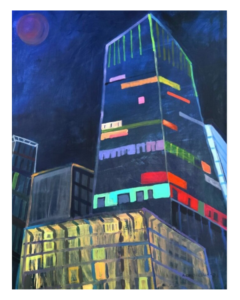
Olivia Star (2023)
The painting is presented by Olivia Star as the central point of the contemporary panorama of Gdańsk. A building that dominates in height, but at the same time remains in dialogue with its surroundings. The glazed body reflects light and changes with the time of day, becoming a moving part of the landscape. The artist shows Olivia Star as a place of observation and at the same time an observed object, a symbol of modernity that sets the rhythm of the city.
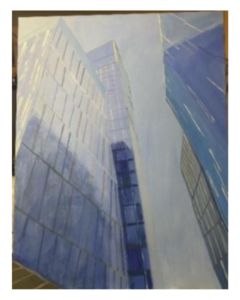
Blue Olivia Star (2025)
From this shot, Star seems almost immersed in blue, blended into the sky. Reflections on the façade turn architecture into a luminous surface that balances between elegance and distance. In the painting, the building becomes a screen for the changing atmosphere: it lives thanks to the light that touches it and thanks to the shadows that model it.
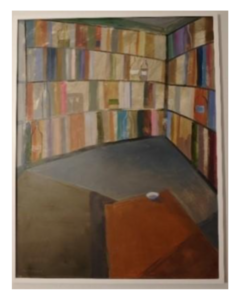
Bodega in Olivia Star (2025)
The painting does not present a faithful record of the interior, but its atmosphere. Wine shelves turn into rhythmic bands of color, and a softly refracted perspective opens up the illusion of space suspended over the city. It is an interior where glass, light and memory intertwine into one story. An intimate counterpoint to the monumentality of the building.
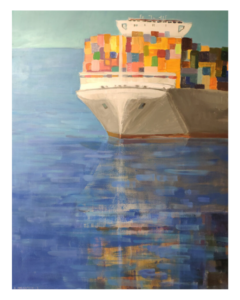
Container Ship (2023)
The container ship becomes a symbolic element of the landscape, often seen from the coastline and the Olivia Star terrace. The colourful modules of the containers create a geometric composition that contrasts with the horizontal calm of the sea. The ship, although global in its function, becomes a sign of everyday life in the landscape of Gdańsk: the rhythm of the port, the flow of goods and constant movement.
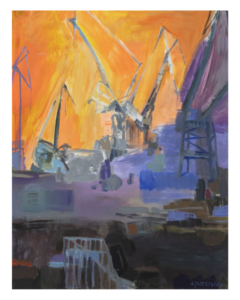
Gdansk – the city of cranes (2020)
Shipyard cranes, a recognizable symbol of Gdańsk, are shown as an element of a permanent landscape — structures that mark the line of the city as strongly as church towers or seaside cliffs. Their presence combines the history of industry, the tradition of the shipyard and the memory of the events that shaped the identity of the city. In the painting, cranes fit into the horizon as witnesses and participants of urban life.
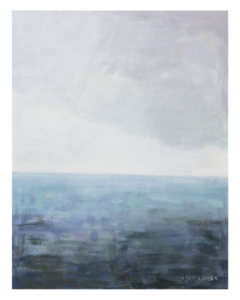
The Baltic Sea – Our Sea (2020)
The Baltic Sea is depicted as a changeable, grey-green, unpredictable, and at the same time deeply painterly sea. The artist focuses on its characteristic color scheme and mood — water, which is not azure, but full of subtle shades, reflections and refractions of light. The sea becomes a natural backdrop for the entire region, the basic horizon line and a source of constant movement.
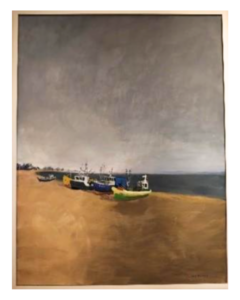
Shore wintering boats (2025)
Wintering boats pulled ashore create a composition of peace and expectation. The colourful hulls, bearing traces of work and weather, are lined up, as if temporarily out of time. It is a scene characteristic of the Polish coast, showing the moment of pause between seasons and the relationship between man and the sea, which takes place in a cycle of returns and rest.
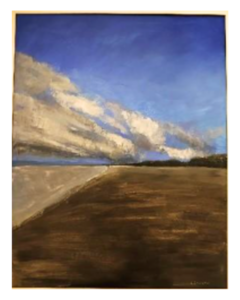
Morning in Jelitków (2025)
The image stops a moment just before the start of the day: empty stretches of beach, blue skies cut by bands of clouds, soft light reflecting off the sand. It is a study of the atmosphere, in which the landscape becomes a space of silence. The morning is shown as a moment of balance between night and day, between silence and the approaching activity of the city.